
Interactive projection, interactive wall, interactive floor, immersive room: when you start shopping for an active play solution, the terms quickly blur together. Yet they describe fairly different experiences that don't suit the same spaces or the same audiences.
What is interactive projection?
Interactive projection refers to any system where a projected image responds to users' movements. A projector displays the content, a sensor or camera detects motion, and a computer makes the image react in real time. The term applies to walls, floors, tables and entire rooms.
What changes from one solution to the next is the surface, the way people interact and the environment around the image. Some systems stop at projection, while others add sound and ambient lighting to create a complete experience, such as an interactive playground.
What is an interactive wall?
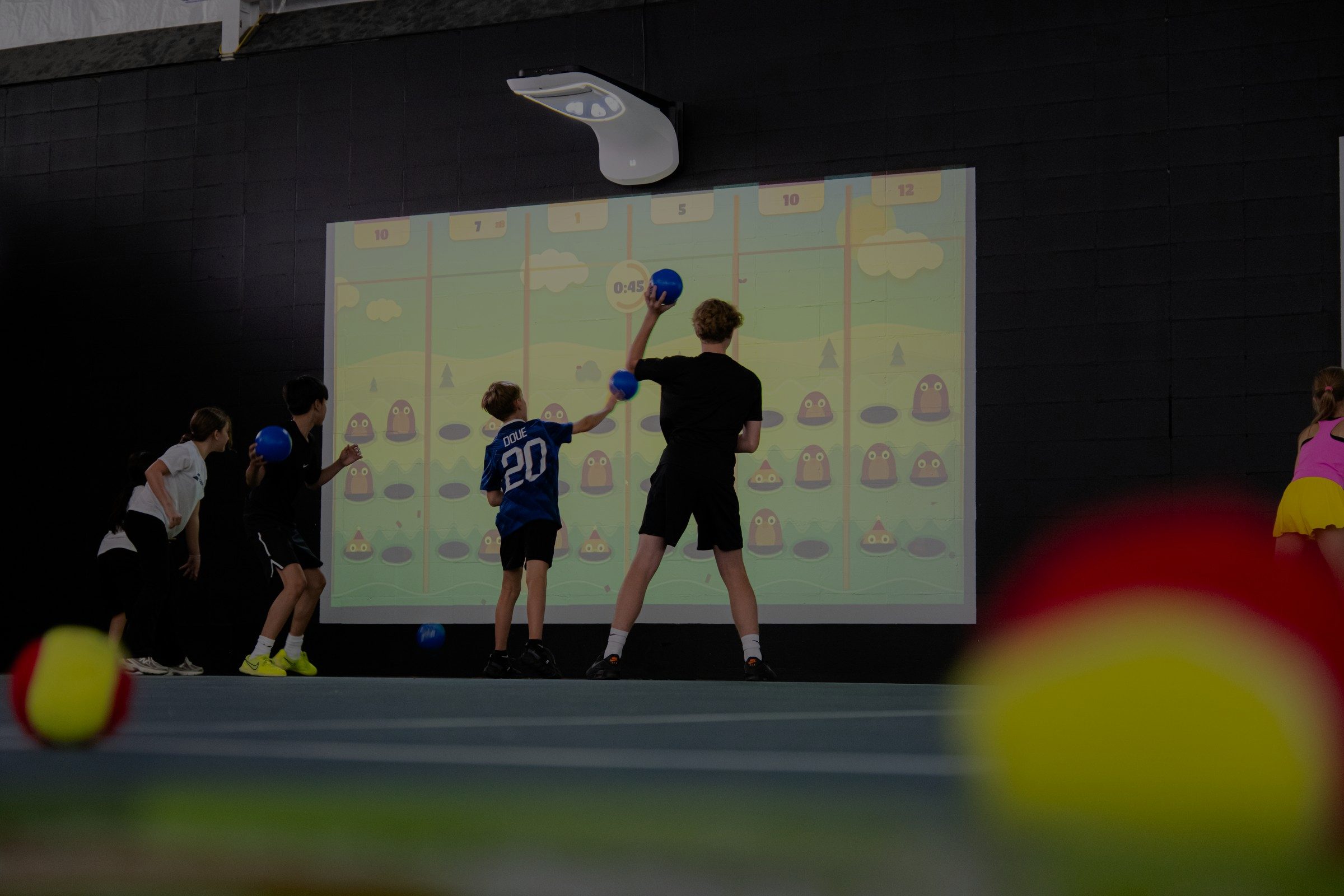
An interactive wall is a vertical surface where a game is projected and responds to ball impacts, touches or players' movements. The projector and sensor are mounted on the ceiling or wall, facing the play surface.
Walls are especially well suited to throwing and precision games, team trivia and activities where the whole group needs to see the screen at once. Because players stand in front of the wall rather than on the image, their bodies block very little of the projection, which allows more accurate detection.
An interactive wall for play shouldn't be confused with large touch screens or interactive whiteboards, which are mostly used in classrooms and meetings. An interactive play wall gets the whole body moving.
What is an interactive floor?
An interactive floor projects the image onto the ground from a ceiling-mounted unit. Players walk, jump or run across the projection to complete a given action.
It does have limits, though: players stand on the image and cast shadows on it, throwing games are difficult, and installation often requires a fairly high ceiling above the play area.
A look at the main differences
The table below sums up what sets the three approaches apart.
| Criterion | Interactive projection | Interactive wall | Interactive floor |
|---|---|---|---|
| Definition | Underlying technology that makes a projected image respond to movement | Projection onto a vertical surface | Projection onto the ground from the ceiling |
| How you play | Varies by format | Throw, touch, move in front of the wall | Walk or jump on the image |
| Strengths | Works on many surfaces | Accurate detection, free or guided play, interaction with hands and balls, whole group sees the screen | Free, intuitive play for young children |
| Limits | Depends on the installation | Needs a clear wall | Player shadows, less variety |
| Best for | Depends on the installation | Schools, senior living, family entertainment, fitness | Early childhood, lobbies, waiting areas |
What about immersive rooms and interactive tables?
Immersive rooms project images onto several walls, sometimes onto the floor too, to fully surround participants. The effect is striking, but they require a dedicated room and a larger budget.
Interactive tables project a game onto a horizontal surface that people sit around. They suit small groups and calm activities but involve little movement. All of these solutions rely on the same interactive projection technology, applied to different formats.
How do you choose for your space and audience?
Start with your goal. If you want to get a group moving, work on precision or offer varied activities from sports to trivia, an interactive wall is usually the most versatile choice. If your audience is mostly toddlers and you're looking for less structured games, an interactive floor can also be a good fit.
Then look at your space. A gym or large room can take a ceiling-mounted installation, while a common room or lounge calls for a more compact format. Your audience matters too: older adults in wheelchairs, for example, play more easily facing a wall than looking down at the floor, and fitness centers need instructions and timers at eye level.
Why did Lü choose the wall?
Lü, which designs interactive playgrounds, uses wall projection for all of its configurations. Wall projection allows more accurate motion tracking, reduces shadows and leaves the floor free for running, throwing and moving around safely.
Each system pairs a laser projector and a motion sensor with a sound system and multicolor LED lighting that follow every game: the music sets the pace, the lights shift the mood, and the whole room becomes an immersive environment. The wall stays at the heart of the action, but it's the atmosphere of the entire room that makes people want to move.
Three configurations fit different spaces: Üno mounts on the ceiling for gyms and large spaces, Möve is the portable version, and Höp is a compact wall-mounted unit for smaller rooms.
Frequently asked questions
What's the difference between an interactive wall and an interactive whiteboard?
An interactive whiteboard is used up close with a finger, like a large touch screen. An interactive play wall is usually played from a distance, by throwing a ball or moving around, and gets the whole body moving.
Is an interactive wall safer than an interactive floor?
With a wall, the floor stays clear, which makes quick movement and throwing games easier. With a floor, players focus on the ground and may bump into each other more during chase games.
Can you turn an existing wall into an interactive wall?
Yes, in most cases. The wall should ideally be painted matte white and kept free of obstacles such as basketball hoops or clocks.
Still weighing your options?
We'll help you choose the configuration that best fits your space.