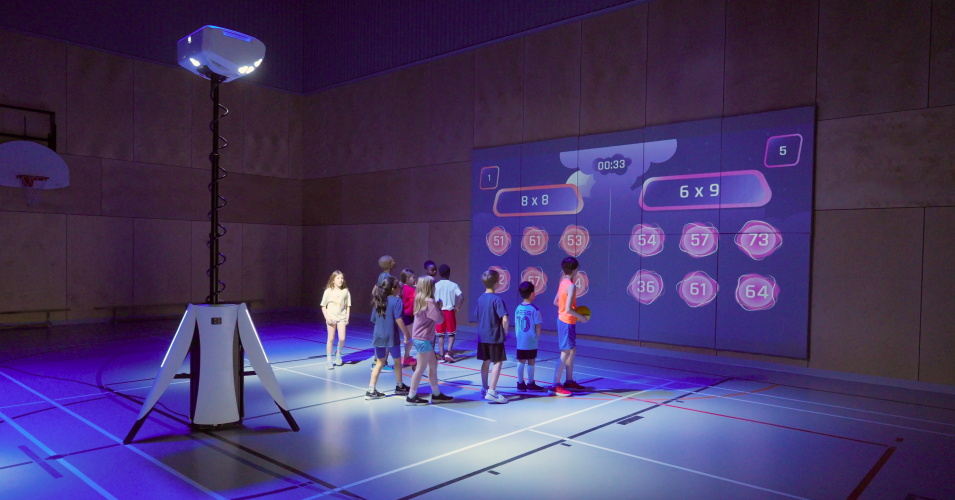

Not all screen time is equal. Discover how technology in P.E. can promote movement, engagement, and meaningful learning.
Screen Time Is Rising, and So Are Concerns
It's no secret that the use and accessibility of technology in schools, and in daily life more broadly, have continued to increase at a rapid pace. Alongside this modern reconfiguration comes clear areas of concern, particularly around prolonged exposure, dependency, and the pervasiveness of screens in young people's lives.
We've heard your concerns about screen time, and we understand the reasoning behind them. The subject of physical education often evokes imagery of traditional sports: basketball, soccer, dodgeball, flag football, laps around the gym or field, callisthenics…
It's not a subject that typically gets associated with technology, and when it does, skepticism and questioning often follow: "Can we at least keep screens out of P.E.?", "Isn't this the one place kids should just be moving?" These are fair questions! For many, physical education represents a break from the screens that already occupy so much of children's time.
Physical Education Is More Than Just Movement
It's important to remember that physical education is not synonymous with physical exercise: when students enter the gym, they're stepping into a different kind of classroom, one that provides students with a planned, sequential, preK-12 standards-based program of curricula and instruction - just the same as other subjects they take in school. In other words, they're not just moving their bodies; they're developing lifelong motor skills, knowledge, and behaviors for active living (SHAPE America, 2026).
With that in mind, the question of "keeping screens out of P.E." becomes a bit more nuanced. As physical education is held to the same standards as other subjects, it also warrants access to the same range of tools that can support learning.
Consider the range of students who enter the gym each class: from elite youth athletes to those who dislike traditional P.E. and need more motivation to move, as well as students with physical or cognitive disabilities and everyone in between. The best way to differentiate instruction is to give students choice in how they show their learning - often by considering the relevance of the tools and environments already shaping how they learn and engage.
SHAPE America (Society of Health and Physical Educators), one of the largest organizations for health and physical education professionals, has also emphasized the importance of technology in P.E in its recent guidance. The organization asserts that authentic learning may not even be able to occur if not for some level of integration of technologies into the gym.
If it demands that technology, in some capacity, belongs in physical education, how can we appropriately bridge the gap between traditional practices and modern, technology-driven approaches, without adding to the already overwhelming exposure of "screen time"?
Not All Screen Time Is Created Equal
Without going too far into semantics, Lü systems are not a "screen", but they are also not representative of the type of passive, high-consumption screen time that often raises concern.
Not all technology exposure is created equal: the experience of scrolling through social media or watching a film at home is fundamentally different from engaging with most educational technologies.
The national recommendation, in both the United States and Canada, for the minimum amount of time spent each day performing "moderate-to-vigorous physical activity" is 60 minutes (CDC, 2024; PHAC, 2016). In an ideal world, students would engage in an hour of physical education every day, but most of us know that this is only the case for a small number of students and schools.
In contrast to the concerns we've received against technological use in P.E., we've often heard another argument in favor of using Lü in the classroom: "The best exercise for kids is whatever gets them moving." It may be tempting to agree point-blank with this sentiment; after all, kids are not moving enough, and if it's technology that is able to get them up, engaged, and participating, it can feel like an easy solution to achieving the 60-minute goal.
Since 2017, our mission has been to not only develop solutions and applications that are fun and engaging for students - that gets them running, jumping, stretching - but that also achieves what every technology that enters the classroom or gymnasium should set out to do: to support teachers by providing a tool that complements their pedagogical strategies and enhances their lessons and their curricular goals for their students.
Lü is neither just a tool to get kids moving, nor is it representative of the type of technology that threatens to replace meaningful human connection or hinder our social/emotional growth. The real question is not whether technology belongs in physical education, but what kind of experiences we want to create for students. If we remove tools simply because they resemble "screens," we risk overlooking opportunities to engage the very students who need it most. If we embrace them without purpose, we risk diluting the integrity of physical education as an academic subject.
Somewhere in between is where the future of physical education lives.
- CDC, Centers for Disease Control and Prevention. (n.d.). Physical activity guidelines for school-aged children and adolescents. Centers for Disease Control and Prevention. cdc.gov/physical-activity-education/guidelines/index.html
- PHAC, Public Health Agency of Canada (2016, January 22). Children and physical activity. Canada.ca. canada.ca/en/public-health/services/being-active/children-physical-activity.html
- SHAPE America. (2023). Appropriate use of technology in physical education. SHAPE America.
- SHAPE America. (2026). Essential components of physical education. SHAPE America.